
🗞️ Why in News ISRO’s GSLV-F18 lifted off from the Second Launch Pad at the Satish Dhawan Space Centre (SDSC SHAR), Sriharikota, late on Friday, 30 October 2026, and placed NVS-03, the third second-generation NavIC navigation satellite, in its intended geosynchronous transfer orbit (GTO). NavIC has been short of working satellites: in July the government told the Lok Sabha that only three were providing positioning, navigation and timing services.
This is not just one more launch. NavIC was designed for seven satellites, and a run of failed atomic clocks and a replacement satellite stuck in the wrong orbit has left it unable to give a position on its own. NVS-03 adds a satellite with a new civilian signal and an Indian-made clock, but it is still in a transfer orbit. What it fixes depends on the next steps, which happen in space, not on the launch pad.
The Launch: What Happened on 30 October
- The flight. GSLV-F18 “is the 20th flight of India’s Geosynchronous Satellite Launch Vehicle (GSLV)”, according to ISRO’s mission page. ISRO’s outcome line is brief: “GSLV-F18 has successfully placed NVS-03 in the intended orbit”, which it describes as a geosynchronous transfer orbit.
- The timing. Before the launch, The Hindu reported it as scheduled for 11:51 pm IST on 30 October. The Hindu’s print report of 31 October says the rocket “lifted off from the second launch pad of the spaceport and 18 minutes later placed the satellite into the intended geosynchronous transfer orbit.”
- The Chairman’s words. The Hindu quotes ISRO Chairman Dr V. Narayanan: “The GSLV-F18 vehicle has successfully and precisely injected the NVS-03 satellite weighing 2250 kg in the intended elliptical orbit.”
- ISRO’s year. By The Hindu’s count it was only the third ISRO mission of 2026, after the PSLV-C62 mission carrying the EOS-N1 satellite on 12 January 2026, which failed, and GSLV-F17, which placed EOS-05 in its intended orbit on 4 September 2026. ISRO calls EOS-05 “India’s first ever imaging satellite from Geosynchronous orbit.”
For context, our 24 October roundup had reported the launch as slated for 30 October; this is the outcome.
The Rocket: GSLV in Its F18 Configuration
India has three operational launch vehicles: the PSLV, the GSLV and the LVM3 (ISRO). ISRO says the GSLV “with indigenous Cryogenic Upper Stage has enabled the launching up to 2 tonne class of communication satellites”, while the LVM3 can launch “4 tonne class of communication satellites and 10 tonne class of payloads to LEOs”. ISRO’s brochure gives GSLV-F18 an overall height of about 50 m, a lift-off mass of about 420 t and three stages, flying with the smaller of the GSLV’s two fairings, the 3.4 m diameter metallic version (the 4 m ogive fairing flew on GSLV-F17).
Inside the GSLV-F18 stack
The three stages, the four strap-ons and the satellite in the fairing, with ISRO’s brochure figures.
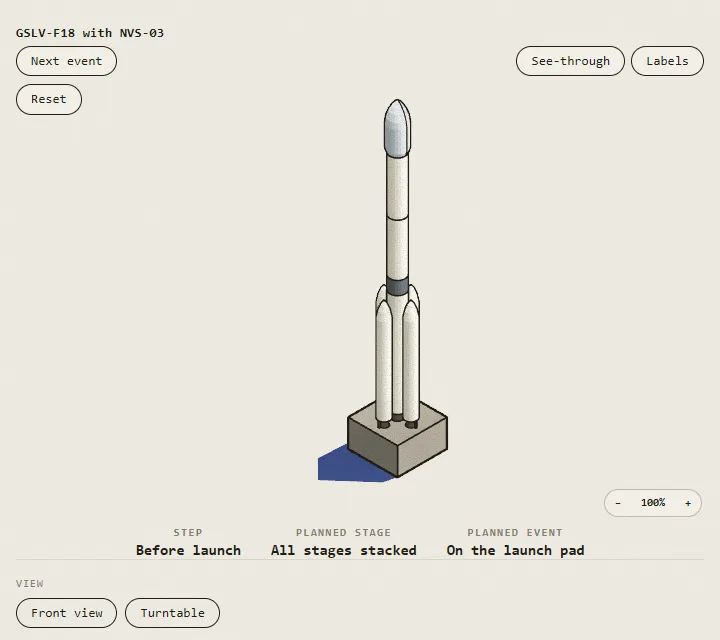 Turn the rocket in 3D
GSLV-F18 propulsion stages at a glance (ISRO mission brochure; the strap-on column covers all four L40H motors together)
| S139 (GS1 core) | 4 L40H (GS1 strap-ons) | GL40HT (GS2) | CUS15 (GS3) | |
|---|---|---|---|---|
| Length (m) | 20.1 | 19.6 | 11.9 | 9.8 |
| Diameter (m) | 2.8 | 2.1 | 2.8 | 2.8 |
| Propellant | HTPB | UH25 + N2O4 | UH25 + N2O4 | LH2 + LOX |
| Propellant mass (t) | 138.2 | 170.6 | 42.1 | 14.4 |
| Stage mass at lift-off (t) | 160.9 | 191 | 47.3 | 17.1 |
ISRO’s general page on the GSLV Mk II adds how the stages work (these are vehicle figures, not F18 measurements):
- First stage: the S139 solid core has a maximum thrust of 4,800 kN and burns for 100 seconds, “while the strap-ons continue to provide thrust for another 40 seconds”. Each strap-on is “powered by one Vikas engine”, and the four strap-ons ignite 4.8 seconds before T0, the reference time for lift-off.
- Second stage: one Vikas engine (UH25 and N2O4) with a nominal maximum thrust of 846 kN, “activated 150 seconds into flight”.
- Cryogenic upper stage: “the CE-7.5 is India’s first cryogenic engine, developed by the Liquid Propulsion Systems Centre”. It burns liquid hydrogen with liquid oxygen in a staged combustion cycle, with a nominal maximum thrust of 75 kN.
From Lift-off to Transfer Orbit
GSLV-F18: from lift-off to the transfer orbit
The order of events ISRO’s brochure planned, the reported outcome, and the step still to come.
ISRO’s pre-launch brochure draws the planned flight in this order: the four L40H strap-ons and the S139 core ignite; GS1 separation and GS2 ignition; IS 1/2 M separation (as ISRO labels it); payload fairing (PLF) separation; GS2 separation and CUS ignition; CUS burn out; and finally NVS-03 spacecraft separation. The one measured figure on record is The Hindu’s: the satellite was in the intended orbit about 18 minutes after lift-off.
The Orbit: From Transfer Orbit to a NavIC Slot
NVS-03’s transfer orbit and the climb still ahead
The planned transfer orbit from ISRO’s brochure, and why the satellite is not yet in its working orbit.
- The planned transfer orbit. The brochure planned a perigee of 170 km, an apogee of 37,023 km and an inclination of 20.75° (plus or minus 0.1°), for a payload of about 2,250 kg. These are planned values: ISRO has said only that the intended orbit was reached, without printing the achieved figures.
- The climb still ahead. NVS-03 is to be raised from this transfer orbit to its operational orbit. ISRO has not said where that will be. For the second-generation satellite before it, ISRO had announced a slot (“NVS-02 will be placed at 111.75ºE replacing IRNSS-1E”).
- NavIC’s slots. In ISRO’s words, “Three satellites of the constellation are placed in geostationary orbit, at 32.5°E, 83°E and 129.5°E respectively, and four satellites are placed in inclined geosynchronous orbit with equatorial crossing of 55°E and 111.75°E respectively, with inclination of 29° (two satellites in each plane).”
Orbit raising is the step that went wrong last time. GSLV-F15 put NVS-02 in an elliptical transfer orbit of 170 x 37,785 km after it was launched in January 2025, but “the orbit raising operations from the elliptical to circular orbit could not be carried out.” ISRO’s failure committee traced it to “the drive signal not reaching the pyro valve of the oxidizer line of the engine meant for orbit raising”, most likely because at least one contact in each of the main and redundant paths of a connector had disengaged. ISRO says the corrective actions were implemented on CMS-03, launched in November 2025 by LVM3-M5, and “will be followed for all future missions, as applicable”. It has not said which of them apply to NVS-03.
What NVS-03 Carries
ISRO describes NVS-03 as “the Third Satellite in Next generation navigation satellite system envisaged for providing continuity of navigation services for IRNSS series”. Five second-generation satellites, NVS-01 to NVS-05, are planned to augment NavIC’s base layer.
- Clocks. “The satellite carries Indigenous Atomic clock, along with the procured Atomic clocks” (ISRO). ISRO has not given their number or type. The Hindu’s explainer says the second-generation satellites carry at least one indigenously developed rubidium atomic clock, developed by ISRO’s Space Applications Centre, to replace imported clocks used on the first generation. NVS-01, launched by GSLV-F12 on 29 May 2023, carried the first indigenous atomic clock to be flown, according to ISRO’s mission page.
- Signals. “It also includes L1 signal in addition to existing L5/S signals.” ISRO calls L1 (1575.42 MHz) “a new civilian signal” that “is also interoperable with the other GNSS signals”; The Hindu’s explainer says it improves interoperability “particularly the U.S.'s GPS”.
- Coverage. India’s land mass “and a region extending 1500 km around Indian geopolitical boundary” (ISRO).
- Mission life. The Hindu reports a mission life of 12 years.
Why NavIC Is Weak, and What the Launch Can Fix
- The clocks. IRNSS-1F, launched in March 2016, completed its 10-year design life on 10 March 2026; on 13 March 2026 its “procured on-board Atomic clock stopped functioning”, ISRO said, though the satellite will continue to function in orbit for one-way broadcast messaging. The Hindu calls it “the last functioning atomic clock aboard IRNSS-1F”.
- The count. For context, in a written reply in the Lok Sabha on 29 July 2026, Minister of State Dr Jitendra Singh said that “presently the NavIC constellation has three satellites for providing PNT services viz., IRNSS-1B, IRNSS-1I and NVS-01. To provide basic positioning service, minimum four operational satellites are required in orbit. Hence, the NavIC constellation cannot provide standalone positioning service, however timing service is functional.”
- The users. The same reply said that “Armed Forces are using multi constellation GNSS including NavIC at present” and that, since NavIC is used alongside other systems “for most of the use-cases, there is no vulnerability for the users.”
So the launch is a necessary step, not the finish. On the government’s own threshold, basic positioning needs a fourth working satellite. NVS-03 can count toward that only after it reaches its operational orbit and is brought into service, and ISRO has not yet announced either. The Hindu says the satellite “is expected to restore the functioning of the NavIC constellation”; that is an expectation, not yet a fact. The reply said NVS-04 and NVS-05 “are in advanced stage of realization”.
Mains Lens: An Independent System Needs a Dependable Pipeline
NavIC’s case for existing is strategic. It offers a Restricted Service for strategic users alongside the civilian Standard Position Service, and The Hindu describes it as “India’s independent regional navigation satellite system”. A regional system with too few satellites cannot give a position on its own, and even the Armed Forces use it alongside other constellations. Three lessons follow.
- Continuity is planning, not luck. IRNSS-1F reached the end of its 10-year design life in March 2026 and lost its clock days later, while the replacement programme had already lost the use of NVS-02. Satellites with fixed lives need replacements launched before the old ones fail.
- Indigenous clocks matter. The weakness has been the clocks. Flying an Indian-made atomic clock, first on NVS-01, then alongside procured clocks on NVS-02, and now on NVS-03, reduces dependence on procured parts for the one component the whole system rests on.
- Launch reliability is part of the system. A navigation constellation is only as good as the rockets and satellite systems that build it. The PSLV-C62 failure of January was being reviewed by a national-level expert committee, ISRO said in February, and The Hindu’s explainer notes that its findings have not been made public.
What to watch: the orbit-raising manoeuvres that are to take NVS-03 from its transfer orbit to its operational slot, ISRO’s statement of that slot, the satellite’s entry into service, and the launches of NVS-04 and NVS-05.
UPSC Relevance
GS Paper 3: Science and Technology: developments and their applications; awareness in the field of space; achievements of Indians in science and technology. Security: the strategic value of an independent navigation system.
Prelims: NavIC (IRNSS), its coverage and its two services; GEO versus inclined geosynchronous orbits; geosynchronous transfer orbit, perigee and apogee; GSLV stages (S139, L40H, GL40HT, CUS15) and the CE-7.5 cryogenic engine; the L1, L5 and S bands; GPS, GLONASS, Galileo and BeiDou.
Mains: “NavIC has struggled to keep enough working satellites in orbit. Examine the causes and suggest how India can make its regional navigation system dependable.” (250 words)
📌 Facts Corner, Knowledgepedia
Prelims, statement-ready facts:
- GSLV-F18: the 20th GSLV flight; launched late on 30 October 2026 from the Second Launch Pad, SDSC SHAR, Sriharikota
- Outcome (ISRO): NVS-03 placed in the intended orbit, a geosynchronous transfer orbit (GTO)
- Planned GTO (ISRO brochure): perigee 170 km, apogee 37,023 km, inclination 20.75°
- GS1: S139 solid core plus four L40H strap-ons; GS2: GL40HT; GS3: CUS15 cryogenic; 3.4 m metallic fairing
- GSLV-F18: height about 50 m, lift-off mass about 420 t, three stages
- NVS-03: about 2,250 kg; the third of five second-generation NavIC satellites (NVS-01 to NVS-05)
- NVS-03 carries an indigenous atomic clock along with procured atomic clocks, and an L1 signal besides L5 and S
- L1 (1575.42 MHz): a new civilian NavIC signal, interoperable with other GNSS signals (ISRO)
- NavIC, formerly IRNSS: India plus a region up to 1,500 km beyond its boundary
- NavIC services: Standard Position Service for civilians; Restricted Service for strategic users
- NavIC design: 7 satellites, 3 geostationary (32.5°E, 83°E, 129.5°E) and 4 inclined geosynchronous at 29°
- Basic positioning needs at least four operational satellites; on 29 July 2026 three were giving PNT (PIB)
- NVS-01 (GSLV-F12, 29 May 2023) was the first to fly an indigenous atomic clock
- India’s operational launchers: PSLV, GSLV (up to 2 tonne class communication satellites) and LVM3 (4 tonne class)
Prelims, the traps:
- NavIC is regional, not global; GPS (US), GLONASS (Russia), Galileo (EU) and BeiDou (China) are global
- Reaching GTO is not reaching the slot: NVS-03 must still raise its orbit and enter service
- NVS-02 (January 2025) reached transfer orbit, but its orbit raising failed: a satellite problem, not a launch failure
- Mission life: 12 years (The Hindu)
- On 29 July 2026 NavIC’s timing service was functional; standalone positioning was not
Mains, arguments and keywords:
- Keywords: strategic autonomy, PNT, atomic clocks, constellation continuity, replacement pipeline, multi-GNSS
- Frame: launch, then orbit raising, then entry into service; four working satellites for standalone positioning
Interview, be ready for:
- “Why does India need NavIC when GPS is free?” It gives strategic users a Restricted Service from an independent system over India’s region.
Sources: ISRO, GSLV-F18/NVS-03 mission page and pre-launch mission brochure, List of GSLV Launches, GSLV Mk II vehicle page, Satellite Navigation Services page, NVS-02 failure analysis and IRNSS-1F update. PIB, Department of Space, Lok Sabha reply on the operational status of NavIC (July 2026). The Hindu, Hemanth C.S., 31 October 2026 (print), and The Hindu explainer on the NVS-03 launch, 30 October 2026. GPS.gov; European Space Agency, types of orbits.
Cite this page: GSLV-F18 Launches NVS-03: NavIC, L1 Signal and Atomic Clocks — Ujiyari.com | Free UPSC & State PCS Current Affairs
